Skip to content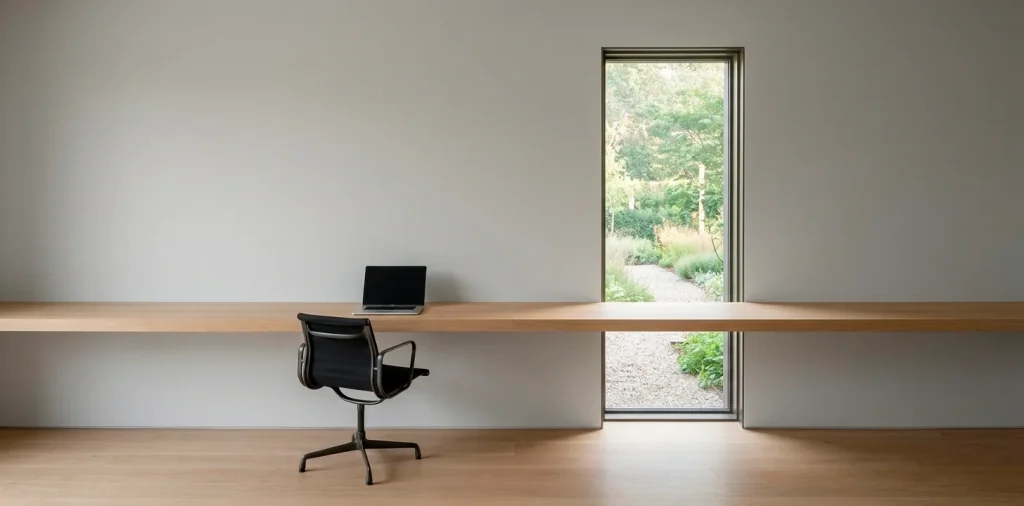
Is your desk currently holding a funeral for your productivity? I once lived in a sea of tangled chargers and half-empty coffee mugs, wondering why my brain felt like a browser with fifty tabs open. Then I discovered the power of the ultra-minimalist setup. It isn’t just about owning less; it’s about making space for your best work to actually happen. Let’s build your sanctuary.
The Floating Desk Foundation
Every minimalist journey starts with the horizontal surface. I swear by the floating desk because legs are just obstacles for your vacuum and your eyes. When you remove the bulky base of a traditional desk, the room suddenly breathes. It creates an illusion of infinite floor space that instantly calms the nervous system.
You want a single, solid slab with zero drawers. Why? Because drawers are just graveyards for things you’ll never use again. If you keep the surface clear and the underside empty, you force yourself to deal with clutter immediately rather than hiding it. Check out these iconic tapered leg minimalist designs for some serious leg-day inspiration if you prefer a standing version.

Defeating the Cable Spaghetti Monster
Nothing ruins a ‘zen’ vibe faster than a black web of power cords crawling down your wall. I honestly think cables are the primary cause of modern anxiety. To achieve that ultra-clean look, you must become a master of concealment. Use an under-desk cable management tray to tuck every power brick and slack line out of sight. I use heavy-duty adhesive clips to run the main power line down the back of a desk leg or behind a wall channel. If I can see a single wire, I’ve failed. It sounds obsessive, but once those distractions vanish, your brain stops tracking the mess and starts tracking your goals. FYI, this is the single most important step for visual peace! 🔌
A useful little gift for your home
🎁 Free Plant Finder Tool
Filter 250+ houseplants by style, size, and care level to find your perfect green companion in seconds.
We’ll email you the link. Plus, you’ll join our newsletter for fresh home inspiration.

One Monitor to Rule Them All
Stop the dual-monitor madness.
I know, I know—you think you need four screens to be productive. But do you really? Every extra screen is another portal for a distraction to creep in.
I switched to a single 34-inch ultrawide monitor and never looked back. It gives you the screen real estate of two monitors without the ugly bezel gap in the middle. It’s a seamless, beautiful canvas for your work.
Plus, it forces you to focus on the task in front of you. When you have multiple monitors, your eyes constantly dart back and forth, which is basically a workout for your procrastination muscles. One screen, one focus.

The Psychology of a Limited Palette
Colors carry emotional weight, so why would you fill your workspace with loud, clashing tones? I stick to a monochrome palette with maybe one natural wood texture to keep things from feeling like a hospital ward. Think whites, grays, and blacks. These colors don’t demand your attention. They fade into the background, allowing your work to take center stage. Ever noticed how high-end art galleries have white walls? They want you to look at the art, not the wallpaper. Treat your work like the masterpiece it is and give it a neutral gallery to live in. It sounds pretentious, but your focus will thank you when you aren’t staring at a neon-orange stapler all day.

Ergonomics Without the Bulk
Most ergonomic chairs look like they belong in a spaceship or a high-stakes gaming tournament. They are huge, plastic-heavy, and frankly, an eyesore. You don’t need a thousand levers to sit comfortably.
I prefer a task chair with a slim profile and breathable mesh. It provides the support you need without dominating the entire room’s visual weight. Look for something with clean lines and a neutral color.
Remember, a chair is a tool, not a centerpiece. If it’s the first thing you see when you walk in, it’s probably too big for a minimalist setup.

Lighting for Deep Focus
Harsh overhead lighting is the enemy of creativity. It creates shadows that make your space feel cluttered even when it’s not. I always prioritize natural light—place your desk near a window if you can, but never directly facing it to avoid glare.
For the evenings, a single, high-quality desk lamp is all you need. I love a lamp with a thin arm and adjustable temperature settings. You want warm light for creative thinking and cool light for high-energy tasks. Keep the design architectural and simple; no fancy shades or ornate bases here.

The One-Object Rule
I have a strict rule for my desk surface: only one non-essential item allowed at a time.
For me, it’s usually a single plant or a high-quality candle.
This one object acts as a visual anchor. It gives your eyes a place to rest without overwhelming your brain with data points.
If you have a plant, a picture frame, a toy, and a stack of mail, your brain is processing all of those things simultaneously. You might find these minimalism japandi hacks to clear clutter helpful for the rest of your home too.

Digital Minimalism Matters Too
Your physical desk can be spotless, but if your desktop is covered in random icons, you’re still cluttered. I treat my digital workspace with the same ruthlessness as my physical one. I use a plain, dark wallpaper and hide all my desktop icons. It feels like a fresh coat of paint every time I wake up my computer. If you haven’t opened a file in a month, archive it. If you have twenty apps in your dock, prune them. Your computer should be a tool for execution, not a digital junk drawer. Keeping your digital environment clean is the final boss of the minimalist setup. 💻

The Power of Negative Space
We often feel the need to fill every empty corner with ‘something.’ A shelf, a floor lamp, a bean bag—resist that urge. Negative space is your best friend in a minimalist office.
Empty space isn’t wasted space; it’s room for your thoughts to expand. I left an entire wall in my office completely blank.
When I’m stuck on a hard problem, I look at that wall. It doesn’t give me any new information to process, which allows my brain to loop back and solve the issue I’m working on. It’s like a reset button for your eyes.

The End-of-Day Ritual
A minimalist office only stays minimalist if you maintain it. I spend exactly two minutes at the end of every day ‘resetting’ my desk to zero. I put my pen away, I move my mug to the kitchen, and I wipe down the surface.
Walking into a clean office the next morning is the greatest gift you can give your future self. It removes the ‘friction’ of starting. If you have to clean your desk before you can start working, you’ve already lost the battle against procrastination. Keep it ready, keep it empty, and keep it focused. IMO, this habit is what separates the wannabes from the pros.

A useful little gift for your home
🎁 Free Plant Finder Tool
Filter 250+ houseplants by style, size, and care level to find your perfect green companion in seconds.
We’ll email you the link. Plus, you’ll join our newsletter for fresh home inspiration.
Conclusion
Transitioning to an ultra-minimalist home office isn’t about being boring; it’s about being intentional. By stripping away the visual noise of cables, clutter, and clashing colors, you build a space that actually respects your focus. I’ve found that my best ideas come when there’s nothing else fighting for my attention. So, are you ready to finally clear that desk and reclaim your brain? Trust me, the silence is worth it. Let me know in the comments which part of your current setup is the biggest distraction—I bet it’s the cables! ✨