Skip to content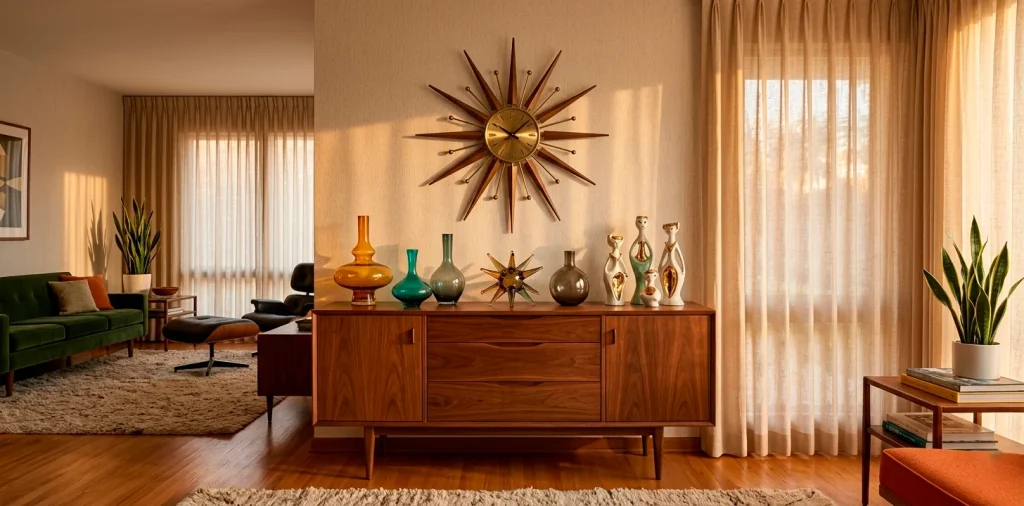
You have likely seen those generic ‘vintage-inspired’ ornaments at big-box stores lately. They look okay from a distance, but they lack the soul of a piece that actually survived the 1950s. Hunting for real-deal mid-century treasures feels like a competitive sport, and I am here to coach you. Ready to stop buying cheap plastic? Let’s find some heirlooms!
Verify the Shiny Brite Stamp
You cannot talk about mid-century ornaments without mentioning the legend: Shiny Brite. Max Eckardt changed history when he moved production to the US during the war. Every serious collector hunts for that specific hallmark.
Check the metal cap immediately. Authentic pieces almost always feature a crimped metal cap with ‘Shiny Brite Made in USA’ stamped clearly on the top. If you see a flimsy, bright silver plastic cap, you are looking at a modern reproduction. Put it back and keep moving.
I once found a pristine box of these at a dusty garage sale for five dollars. I practically sprinted to my car before the owner realized they were worth ten times that! Always trust the engraving over the paint job.

Identify Hand-Painted Imperfections
Mass-produced modern junk uses machines to print perfect, soulless lines onto glass. Real MCM ornaments have personality because human hands actually touched them. Look for slight wobbles in the glitter or uneven paint applications.
A useful little gift for your home
🎁 Free Plant Finder Tool
Filter 250+ houseplants by style, size, and care level to find your perfect green companion in seconds.
We’ll email you the link. Plus, you’ll join our newsletter for fresh home inspiration.
IMO, these little ‘flaws’ provide the best proof of age. Authentic artisans applied mica and lacquer in ways that modern factories simply cannot replicate. Do the stripes look a tiny bit wonky? That is exactly what you want to see. 🎨

Check for Mercury Glass Age Spots
Authentic mercury glass undergoes a natural oxidation process over seven decades. This creates beautiful, dark ‘age spots’ or a subtle cloudiness inside the glass. Modern replicas look too perfect and uniform because they lack this history.
Ever wondered why some ornaments look a bit ‘ghostly’ inside? That is the silvering wearing away. I personally find this patina much more attractive than a shiny new ball. It tells a story of decades spent in a family attic.
Specific aging characteristics:
- Dark spots near the neck of the ornament
- Internal silvering flaking off in small scales
- A soft, diffused glow when held up to the light
Don’t let a little wear scare you away. In the world of vintage, a bit of ‘character’ usually confirms that you found the real thing.

Assess the Weight and Material
Pick it up! Seriously, the weight tells you everything. Authentic mid-century ornaments use incredibly thin, delicate glass. If the ornament feels heavy or thick like a paperweight, it is likely a modern glass piece or, heaven forbid, plastic.

Examine the Caps and Wire Hooks
The hardware often reveals the truth faster than the glass itself. During the 1940s and 50s, manufacturers used specific metal alloys for the caps. Most authentic caps have a dull, matte finish rather than a high-gloss chrome look.
Do you see a simple wire loop that looks like it might snap? That is a great sign. Modern manufacturers use reinforced, sturdy hooks that look entirely too industrial. I always carry a small magnifying glass to check these tiny details at flea markets.
FYI, if the cap has a ‘floral’ or ‘petal’ shape, you might have found an early European import. These pieces command much higher prices among enthusiasts. Pay attention to the metalwork and you will rarely get cheated.

Hunt for European Origins
While Shiny Brite ruled the US, the real ‘fancy’ stuff came from West Germany, Poland, and Italy. These ornaments often feature more complex shapes and higher-quality glass. Look for small paper tags or stamps on the metal caps that mention these countries. West German pieces, in particular, represent the gold standard for many collectors. If you find a ‘Made in West Germany’ stamp, buy it immediately. mastering mid-century aesthetic iconic silhouettes.

Identify Iconic Atomic Shapes
The Space Age influenced every part of mid-century design. Ornaments were no exception! You want to find shapes that scream ‘1958’. Look for indentations, teardrops, and elongated spindles.
Atomic design elements to look for:
- ‘Reflector’ ornaments with deep, concave centers
- Double-indented spheres that catch the light from all angles
- Starburst patterns etched directly into the glass
- Elongated ‘Finial’ shapes that look like rocket ships
These shapes are much harder to replicate than a simple sphere. I find that collectors fight over the deep reflectors the most. If you see a bright pink reflector with a contrasting turquoise center, you have found the holy grail of atomic decor. Have you ever seen anything more iconic than a glass rocket ship on a tree?

Evaluate the Surface Finish
True mid-century ornaments used a specific type of lacquer that modern companies find too expensive to use. This finish has a ‘depth’ to it that you just don’t see on cheap modern balls. It looks almost like a liquid coating rather than a sprayed-on paint.

Know Your High-End Designers
Not every ornament came in a cardboard box from a department store. Some were true works of art. If you are serious about this, start researching names like Holmegaard or Murano. These glassmakers produced stunning ornaments that lean more toward ‘sculpture’ than ‘holiday decor’.
Murano pieces often feature ‘Millefiori’ or ‘Latte’ techniques that look incredibly intricate. These are the ones you keep in a display case year-round. Don’t expect to find these for a dollar at a thrift store, though.
Key luxury features:
- Heavy, solid glass bases in Murano pieces
- Distinctive ‘swirl’ patterns inside the glass
- Signed or etched bases on designer figurines
- Artist-specific color palettes like sommerso glass
I treat my Murano ornaments like family members. I actually think I like them more than some of my cousins. Is that bad? Probably. But they look amazing on my mantle.

Scout the Right Locations
Where you look matters just as much as what you are looking for. Antique malls are great, but they usually know exactly what they have and price it accordingly. For the best deals, you have to get your hands dirty.
Estate sales in older neighborhoods are your best friend. Look for ‘time capsule’ homes where the owners haven’t moved since 1965. You might just find a whole attic full of original boxes. Trust me, the thrill of the hunt is half the fun! 15 tips mid-century modern guest room.

A useful little gift for your home
🎁 Free Plant Finder Tool
Filter 250+ houseplants by style, size, and care level to find your perfect green companion in seconds.
We’ll email you the link. Plus, you’ll join our newsletter for fresh home inspiration.
Conclusion
Finding authentic mid-century ornaments takes a bit of patience and a sharp eye, but the payoff is worth it. Nothing compares to the glow of real mercury glass and the history behind a hand-painted starburst. Which of these tips are you going to use on your next thrift trip? Let me know in the comments, and happy hunting for those atomic treasures!