Skip to content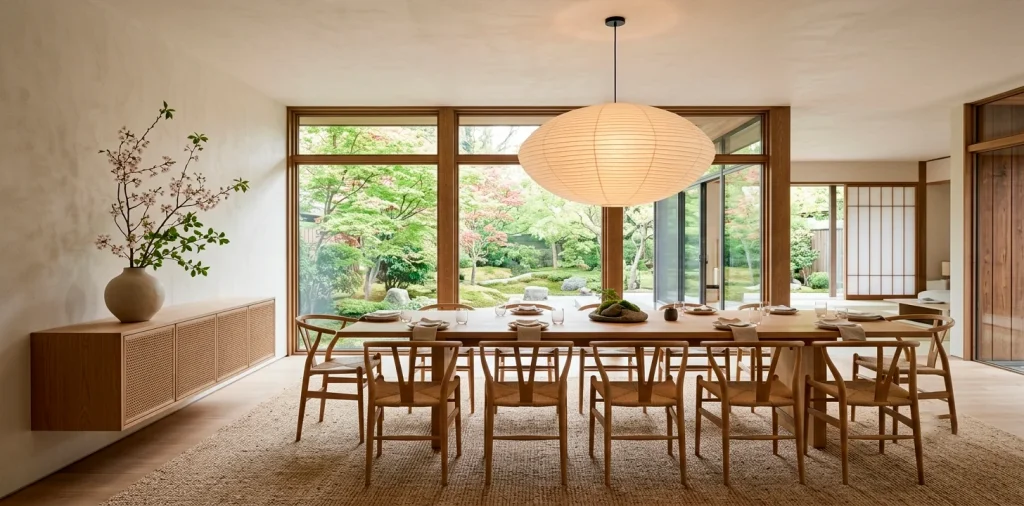
Ever wondered how some dining rooms just radiate absolute zen while still feeling insanely cozy? That’s the magic of Japandi style, merging Japanese minimalism with Scandinavian hygge. I struggled for years trying to find the right balance without making my space look like a sterile clinic. Let’s explore 15 essential pieces to nail this vibe completely.
Low-Profile Wooden Dining Table
Your dining table sets the entire stage for the room. You absolutely need a low-profile wooden table to anchor the space. I personally hunted down a solid oak beauty last year, and it completely transformed my daily meals.
Opt for clean lines and raw, natural finishes. Forget those bulky, ornate farmhouse tables; Japandi demands elegant simplicity. The grain of the wood should do the talking, bringing organic warmth right into your home. Key features to look for:
- Low-profile height for a grounded feel
- Solid oak, walnut, or ash construction
- Matte, unvarnished natural finish
You want a piece that grounds the room beautifully without overpowering it.

Wishbone-Inspired Dining Chairs
What good is a stunning table without equally impressive seating? Enter the wishbone-inspired dining chair. These chairs masterfully combine woven paper cord seats with smooth, curved wooden frames. They look incredible, and surprisingly, they offer fantastic lumbar support. You literally get the best of both worlds—form and function wrapped into one neat, Scandinavian-leaning package. I bought a set of four, and they instantly elevated the entire aesthetic of my dining area. Plus, they slide perfectly under a minimalist table.
A useful little gift for your home
🎁 Free Plant Finder Tool
Filter 250+ houseplants by style, size, and care level to find your perfect green companion in seconds.
We’ll email you the link. Plus, you’ll join our newsletter for fresh home inspiration.

Minimalist Slatted Wood Bench
Mix up your seating arrangement by throwing a minimalist wood bench on one side of the table. It completely opens up the visual space.
Why do we love benches so much? Because they force a sense of communal dining while keeping the room feeling airy and uncluttered. I keep a slatted ash wood bench in my setup, and my guests always fight over who gets to sit there.
Just ensure you match the wood tone closely to your primary table. You want visual harmony, not a chaotic clash of different stains competing for attention in a serene room.

Floating Rattan Buffet
Storage presents a real challenge when you want to maintain a minimalist vibe. A floating rattan buffet solves this problem brilliantly. By mounting the credenza to the wall, you keep the floor space completely clear, which tricks the eye into thinking the room feels much larger. The woven rattan doors add that essential Japanese textural element while hiding all your ugly Tupperware and extra napkins out of sight. Who says practicality has to look boring? You definitely need one of these to maintain that clean, uncluttered aesthetic.

Wabi-Sabi Stoneware Display Cabinet
Embrace the beauty of imperfection with a wabi-sabi stoneware display cabinet.
You do not need pristine, flawless glass boxes in this design scheme. Instead, look for a tall cabinet featuring textured glass or raw, unpolished wood edges.
I use mine to showcase a small, curated collection of asymmetrical ceramic bowls and vintage teacups. It feels deeply personal and highly intentional.
This piece alone adds incredible depth to the room. It gives your dining space a soul, proving that authentic character always beats manufactured perfection.

Oversized Paper Lantern Pendant
Lighting literally makes or breaks your entire Japandi atmosphere. Ditch the heavy, industrial metal chandeliers immediately. Instead, hang a massive, delicate paper lantern pendant light right above the center of your dining table to anchor the room.
The rice paper diffuses the light so beautifully, casting a soft, warm, and inviting glow across your dinner parties. It practically forces everyone to relax. I installed a slightly oversized globe lantern, and it feels like a literal cloud hovering above our meals. Trust me, it changes everything.

Boucle Upholstered Accent Chairs
Bring some serious textural contrast to the head of your table with boucle upholstered accent chairs.
Wood and paper elements dominate this aesthetic, so you desperately need a touch of softness to balance things out. Boucle fabric provides that cozy, nubby texture that practically begs you to touch it.
Choose creamy whites or soft oatmeal colors. These shades blend seamlessly into the neutral palette while adding a luxurious, tactile dimension. IMO, a room without texture falls totally flat 😅.

Slatted Wood Room Divider
Open floor plans often lack definition, leaving your dining space floating awkwardly in the middle of nowhere. A slatted wood room divider fixes this instantly. You get the structural separation of a wall without actually blocking out any natural light. The vertical wooden slats draw the eye upward, making your ceilings look higher, while casting absolutely stunning geometric shadows when the afternoon sun hits them just right. It creates a secluded, intimate dining nook while keeping the modern, airy flow completely intact.

Neutral Jute Area Rug
Ground your entire dining setup with a massive, neutral jute area rug. You need something substantial to tie the table and chairs together visually, and raw, natural fibers accomplish this flawlessly. Honestly, a bare floor just feels a bit too cold for this aesthetic.
Jute brings an earthy, grounded energy that perfectly aligns with Japandi principles. Plus, it handles heavy foot traffic and chair scraping like an absolute champion. Avoid loud, bright patterns; stick to solid, natural tones to maintain that tranquil vibe.

Organic Shape Wall Mirror
Walls in a minimalist room usually stay pretty bare, but you absolutely still need something dynamic to bounce the light around the space.
Enter the organic shape wall mirror.
Ditch the rigid squares and perfect circles. You want a mirror with fluid, asymmetrical lines that mimic natural forms like puddles or stones.
I hung a massive asymmetrical mirror opposite my window, and it doubled the natural light in the room. It acts as functional art, bringing a soft, unexpected dynamism to an otherwise structured space.

Ceramic Pedestal Side Table
You might not think you need a ceramic pedestal side table in a dining room, but trust me, you do. Place one snugly in the corner to hold a statement vase or a structural branch. The smooth, cool surface of the ceramic contrasts brilliantly against the warm wooden furniture. It serves as a tiny, sculptural pedestal that draws the eye without cluttering the floor plan. I use a matte charcoal one to display a single, dramatic cherry blossom branch, and it basically serves as the focal point of the entire room.

Minimalist Bamboo Bar Cart
Entertaining requires logistics, and a bamboo bar cart handles those logistics beautifully.
Instead of choosing a heavy, imposing wooden bar cabinet, a lightweight bamboo cart keeps the energy fresh and incredibly mobile. The natural nodes and slight imperfections of the bamboo stalks add subtle organic texture to the room.
Stock it with some minimalist glassware and a few bottles of your favorite spirits. It rolls perfectly into a corner when you finish mixing drinks, maintaining that clean, uncluttered visual landscape we crave.

Raw Wood Floating Shelves
Dedicate a small section of your wall to some raw wood floating shelves. These provide the perfect stage for the ultimate Japanese accent piece: the bonsai tree.
A carefully pruned bonsai brings literal life and intense focus to the dining room. Pair the greenery with a couple of unglazed clay mugs or a minimalist teapot. This tiny curation of objects brings immense personality to the space without overwhelming it. If you want to weave in more romantic minimalism, these work beautifully alongside Japandi style accents for a minimalist Valentine’s Day.

Linen Upholstered Banquette
If you have a slightly awkward corner, a linen upholstered banquette solves your layout problems instantly. This seating option maximizes your available square footage while injecting a massive dose of Scandinavian comfort. The breathable, slightly wrinkled texture of natural linen feels relaxed and utterly unpretentious. I absolutely love how a banquette turns a standard dining room into an inviting, cafe-like nook. You just add a few muted throw pillows, and suddenly everyone wants to linger at the table for hours after dinner ends.

Matte Black Minimalist Stools
Every space needs a tiny punch of contrast to keep things interesting. Add a couple of matte black minimalist stools to your dining setup.
While Japandi relies heavily on light woods and neutral tones, an injection of stark black grounds the airy aesthetic. It provides a sharp, modern edge.
I keep two low-profile black ash stools tucked near the window. They act as extra seating when I host larger crowds and serve as chic plant stands the rest of the time. They transition beautifully if you ever follow a beginner guide to organic modern living room design.

A useful little gift for your home
🎁 Free Plant Finder Tool
Filter 250+ houseplants by style, size, and care level to find your perfect green companion in seconds.
We’ll email you the link. Plus, you’ll join our newsletter for fresh home inspiration.
Conclusion
You do not need to overhaul your entire house to achieve a perfectly balanced Japandi dining room. By thoughtfully curating these 15 essential pieces, you instantly merge the warm comfort of Scandinavian design with the striking elegance of Japanese minimalism. It takes a little patience to find the right textures, but the serene result absolutely pays off. Which of these pieces are you grabbing first? Let me know in the comments!